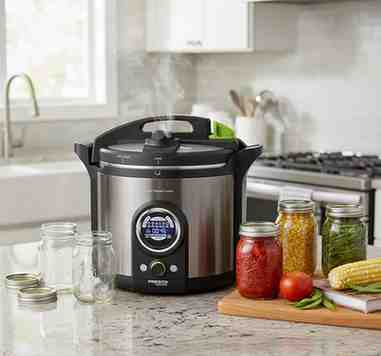
Choosing the best pressure cooker for canning is one of the most important decisions you can make for home food preservation. I learned this after years of trial, error, and research. Initially, I thought any pressure cooker would suffice. I later found that a pressure cooker and a pressure canner are quite different.
That is why pressure canners exist. They safely preserve low-acid foods. This includes meat, vegetables, poultry, and beans. These are common recipes people like to preserve. For safety, follow USDA canning guidelines. They protect your food and your family.
In this guide, i will walk through five popular models. I will explain what makes each one special. At the same time, i will keep everything easy to understand. If you are a beginner or an experienced canner, this article will help you choose cofidently.
Our favourite pressure canner |
If you want the best all-around pressure canner for big batches, go with the Presto 23-Quart — it holds the most jars and handles all low-acid foods safely. For durability and long-term use, the All-American 915 is the strongest choice with its metal-to-metal seal and precise gauge. If you prefer easy, guided pressure canning with digital controls, the Presto Precise Digital 12-Qt is the easiest option for beginners, even though it holds fewer jars.
Our top pick pressure canner |
Best overall—Presto 23-quart pressure canner
Best for Small Batches – Presto 16-Quart Pressure Canner
Best Heavy-Duty – All American 915 Pressure Canner
Best Budget Large Canner – Mirro 22-Quart Pressure Canner
Best Electric/Modern – Presto Digital Pressure Canner
Why Choosing the Right Pressure Canner Matters
Canning is not just cooking. Instead, it is a preservation method that must destroy harmful bacteria. Low-acid foods can contain botulism spores, which are invisible and dangerous. These spores can only be destroyed at very high temperatures.
Because of this, boiling water is not enough.
Pressure canners solve this problem. They trap steam and increase pressure inside the pot. As a result, the temperature rises above 240°F (116°C). This is the level required for safe canning.
Therefore, using the wrong equipment is risky. Choosing the right pressure canner is essential.
Pressure canner test |
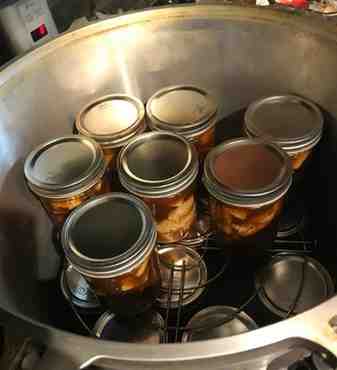
To test each pressure canner, we followed a real home-canning process from start to finish, using meat canning, which is one of the most demanding tests for any pressure canner.
First, we washed and inspected all jars, lids, and rings to be sure everything was clean and damage-free. Then we prepared raw meat, packed it into quart jars, and followed USDA-recommended headspace and salt guidelines. We used hot water and clean rims to reduce sealing failure.
Next, we preheated the pressure canner with the required amount of water and always used a canning rack to prevent jar breakage. After loading the jars, we locked the lid according to the manufacturer’s instructions and vented steam for 10 minutes to remove trapped air. This step is critical for accurate pressure and food safety.
We tested pressure control by bringing the canner up to the correct PSI based on altitude and monitored it closely for the full 90-minute processing time required for meat. During this phase, we checked how well each canner held steady pressure without constant adjustment.
After processing, we turned off the heat and allowed the canner to cool naturally, without forcing pressure down. Once pressure returned to zero, we removed the jars and let them cool for 16–24 hours before checking seals.
USDA Guidelines for Pressure Canning (Very Important)
Before reviewing any model, we like to talk about USDA guidelines. These rules exist for safety, not convenience.
According to the USDA and National Center for Home Food Preservation:
Only pressure canners are approved for canning low-acid foods
Most pressure cookers are NOT approved
A pressure canner must:
Hold at least 4 quart jars
Reach and maintain 10–15 PSI
Allow accurate pressure control
Additionally:
Dial gauges must be tested regularly
Weighted regulators must match recipe pressure
Processing times must never be shortened
Because of this, digital pressure cookers are usually not recommended for canning low-acid foods, even if they claim high pressure.
We will explain this more when reviewing the Presto Digital Pressure Cooker.
Pressure Cooker vs Pressure Canner: Simple Explanation
There are solid differences between a pressure cooker and a pressure canner. They look similar, and both use pressure. I used a pressure cooker at the beginning for everyday cooking; later i purchased a pressure canner to preserve my apple juice. However, you can use it for preserve food, meat and vegetables.
Pressure cooker |
A pressure cooker is made for everyday cooking. I use it to cook rice, lentils, meat, and vegetables faster. I use a pressure cooker because when I cook rice in a rice cooker, it requires more time, but using a pressure cooker, it just takes 15 minutes to cook. The reason behind the faster cook is that it uses high pressure to cook. Also, it is perfect when I am busy and want a quick meal. Most homes already have one, and it is easy to use.
Pressure canner |
On the other hand, a pressure canner is made for food preservation. People use it to store food like meat, fish, vegetables, and sauces for a long time. It reaches a higher and more controlled temperature than a pressure cooker. Because of that, it can safely kill harmful bacteria. This is very important when you want to store food in jars for months.
Now, here is the main difference. A pressure cooker is for eating now, while a pressure canner is for eating later. Even though a pressure cooker uses pressure, it is not safe for canning low-acid foods. That is why experts do not recommend using it as a pressure canner.
What to look in a pressure canner
1. Meets USDA Home Canning Safety Standards
A real pressure canner is designed to safely process low-acid foods like vegetables, meats, poultry, and broth. To meet USDA home canning recipes and heating times, the canner must be able to hold at least four quart-size jars and maintain proper internal pressures throughout processing
2. Capacity & Jar Fit
Think about how many jars you want to process at once:
Smaller canners (e.g., ~16 qt) usually hold about 7 quarts or ~10 pints.
Larger canners (e.g., ~22–23 qt) often hold ~7 quarts and many more pints — sometimes over 16–20 pints in two layers.
Choose a size that matches your batch size. Bigger isn’t always better if you don’t plan to can large quantities — but too small means more batches and more work.
3. Pressure Gauge Type: Dial, Weighted, or Digital
Pressure canners deliver safe, high temperatures by reaching specific pressure levels. How they show that pressure matters:
📌 Dial Gauge
Shows the exact pressure number on a dial.
Should be tested annually for accuracy (at extension offices or with manufacturer support).
Precise reading helps at higher altitudes when fine adjustments matter.
📌 Weighted Gauge
Uses weights that rock or jiggle to indicate correct pressure (5 lb, 10 lb, 15 lb).
Usually does not require annual calibration, and the sound/rocking tells you it’s working.
Simple and reliable once you learn the rocking pattern.
📌 Digital
Some newer models manage timing and pressure automatically.
Make sure any digital canner is specifically designed and tested for pressure canning foods safely — not just pressure cooking.
4. Safety Features You Can’t Skip
A safe pressure canner should include these:
Locking lid that won’t open under pressure.
Steam vent/air vent port that you can see or use correctly as part of the venting process.
Overpressure plug or safety valve, which relieves excess pressure if needed.
Gaskets or metal-to-metal seals that are in good condition so steam doesn’t leak.
Always inspect and replace worn parts — especially gaskets — before using a canner. A crack
5. Material & Build Quality
Pressure canners are usually made from:
Aluminum
-
Lightweight.
-
Heats up quickly and evenly.
Stainless Steel (sometimes with aluminum base)
-
More durable and often induction-compatible.
-
Better for heavy use and longer lifespan.
Consider what you want long-term and what stove type you have (gas, electric, or induction).
Best for Small Batches – Presto 16-Quart Pressure Canner
Reason to Buy |
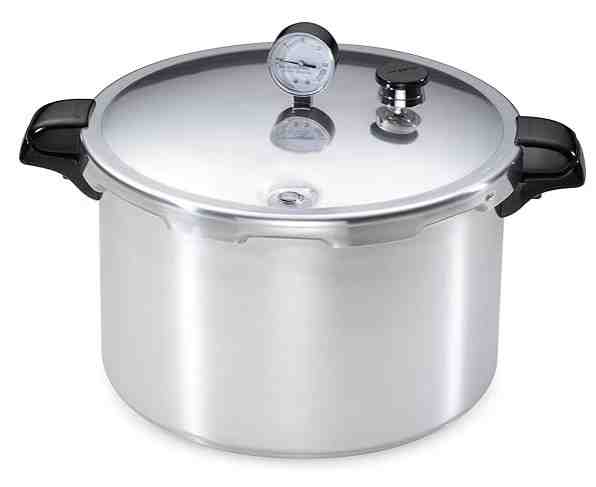
The first reason to buy the Presto 16-quart canner is its reliable performance. Interestingly, the Presto pressure canner is the winner in this article. Because it can build pressure smoothly and hold it steady. This is important for safe canning, especially if you are working with low-acid food.
Another good reason is its simple design. It uses a weighted regulator instead of a dial gauge. Because of this, there is less to worry about when it comes to calibration or gauge accuracy. For many people, this makes the canning process feel less stressful.
It is also a great option if you are new to canning or returning after a break. The size is manageable, and it fits well on most stovetops. At the same time, it is large enough to handle small-batch canning without feeling overwhelming. Lastly, the Presto 16-quart canner is often easy to find at a lower price, especially if you buy it used. With proper cleaning and a test run, a used Presto canner can work just as well as a new one.
Jar capacity | How many jars you can actually use |
One of the best reasons to buy the Presto 16-quart canner is its jar capacity. It comfortably holds:
Ten pint jars at a time, or
seven quart jars at a time
This is perfect if you are doing small to medium canning batches — especially during your first few times canning. You won’t waste water or heat, and it’s easier to manage than a huge canner when you’re new.
Reasons to Ignore |
One reason some people may want to skip this canner is that it does not have a dial gauge. If you prefer seeing exact pressure numbers, this design might feel uncomfortable at first. Another drawback is the limited capacity. However, another Presto 23-quart is also available if you want big size.
Key Specs |
Brand:Presto | Manufacturer: National Presto Industries | Color: Silver | Dimensions: Height: 10.5 inches | Width: 11 inches | Length: 11.5 inches
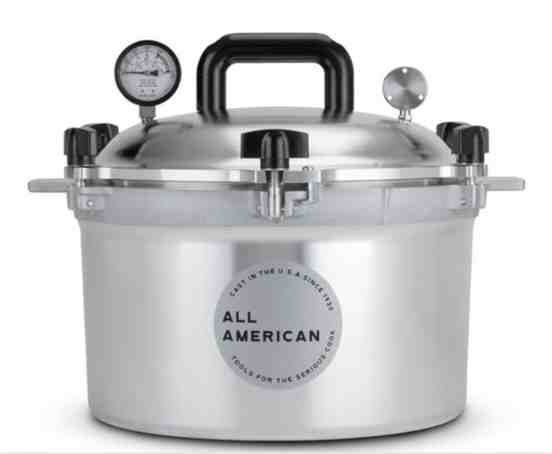
Best Heavy-Duty – All American 915 Pressure Canner
Reason to Buy |
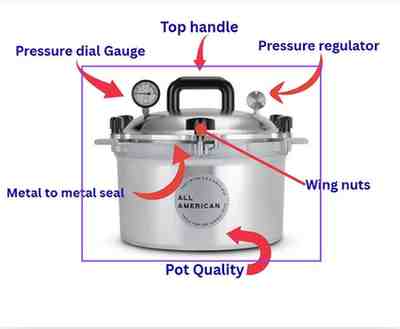
One strong reason to buy the All-American 915 canner is its solid and durable build; it can last over a decade. This canner does not use a rubber gasket. Instead, it has a metal-to-metal seal. Because of that, there is no gasket to crack. Unlike the All American pressure canner, other models have rubber gaskets. Since it has no gasket to crack, dry out, or replace, you just need to use light oil before reuse in order to seal it with oil. I always use olive oil while using it.
Another good reason is its manageable size for beginners. The 915 is not the biggest model, and that is actually a benefit if you are just starting out. These canners are heavy, so choosing a slightly smaller size makes it easier to handle, lift, and store. For a small or medium garden, this size feels just right. Moreover, It comes with a pressure gauge and a weighted regulator that allows 5, 10, or 15 pounds of pressure. The pressure control system is another plus point.
It is also a great choice if you want to can healthy, homemade food. This model works well for things like tomato sauce, chicken broth, and beef broth. If you cook from scratch and want to avoid processed foods, this canner helps you store homemade meals safely for later
Reason to Ignore |
Even though it is smaller than other All-American models, it is still heavy. If lifting heavy cookware is difficult for you, this may be a concern. Moreover, the cost of the All-American price is higher than the Presto 16-quart models.
Jar capacity of the All-American pressure canner |
- Up to 10 pints jars at a time, or
- Up to 7 quarts jars at a time
Key Specs |
Brand: All-American| Manufacturer: All-American | Color: Silver Dimensions: Height: 12 inches | Width: 11.5 inches | Length: 12 inches | Pressure Indicator: Dial gauge
Reason to Buy |
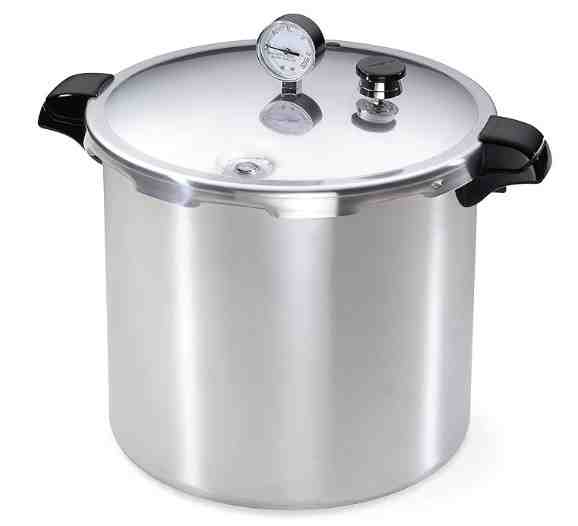
One of the biggest reasons to buy the Presto 23-quart pressure canner is its large jar capacity. If you like big-batch canning, then the Presto 23-quart is the best options for you . This model can hold :
- Up to 20 pints jars at a time or
- Up to 7 quart jars at a time
- Up to 26 half-pints
This makes it an excellent choice if you grow a lot of vegetables or want to can food in fewer batches.
Another strong reason is that it meets USDA home canning guidelines. It is designed to safely process low-acid foods like vegetables, meat, poultry, fish, and stocks. That gives me a lot of confidence, especially when food safety matters.
You can use it for both cannning and cooking purpose . As a result, you don’t require extra pressure cooker for cooking daily meal .
Reason to Ignore |
The major drawback of this pressure canner is its heavy weight. When it is filled with full jars and water, it can weigh over 50 pounds. If you have difficulty with heavy cookware, this may be a problem. This canner can feel too large for small households. If you can only a few jars at a time, this model may be more than you need. For this reason, i think, you should go for presto- 16 quart pressure cooker.
Key Specs |
Brand:Presto | Manufacturer: National Presto Industries | Color: Silver Dimensions: Height: 11.5 inches | Width: 12.5 inches | Length: 13 inches
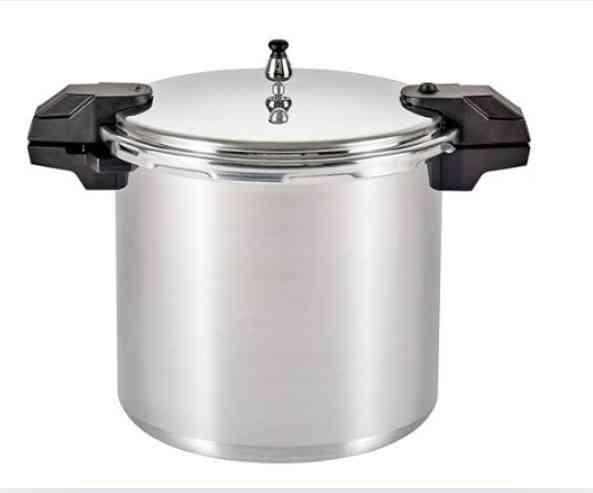
Best Budget Large Canner – Mirro 22-Quart Pressure Canner
Reason to Buy |
This is another budget-friendly pressure canner after the Presto 16-quart canner. The first thing I really like most about the Mirror 22-quart pressure canner is the silicone gasket. Unlike rubber gaskets, silicone holds its shape better and lasts longer. Because of that, you don’t have to worry as much about leaks or frequent replacements.
Another smart design feature is the plug on the underside of the lid. This helps keep food particles from going up into the vent pipe. As a result, cleaning is easier, and pressure flow stays more consistent.
This canner also comes with two canning racks. That means you can stack jars in two layers, which saves time and lets you process more food in one batch. For anyone who cans meat, vegetables, or broth regularly, this is a big advantage.
When it comes to pressure control, Mirro keeps things simple. There is no dial gauge. Instead, it uses three weighted regulators:
5 lb
10 lb
15 lb
Moreover, the canner itself feels solid and well-built, yet it’s lighter than many heavy cast aluminum models. Plus, it has a clean, polished look that many culinary expert appreciated in their kitchen. Finally, Mirror also includes a basic user manual and recipe guide. The instructions are clear and helpful, especially if you’re new to pressure canning.
🫙 Jar Capacity
The Mirro 22-quart pressure canner can typically hold:
Up to 7 quart jars, or
Up to 18–20 pint jars (depending on stacking and jar style)
Reasons to Ignore the Mirro 22-Quart Pressure Canner
One possible downside is the lack of a dial gauge. While weighted systems are reliable, some beginners prefer a gauge because they like seeing the exact pressure number.
Another thing to consider is that this canner still uses a gasket system. Even though the silicone gasket is more durable than rubber, it will still need checking and eventual replacement.
Key Specs |
Brand: Mirro | Manufacturer: Mirro | Color: Silver Dimensions: Height: 11 inches | Width: 12 inches | Length: 12 inches | Capacity: 22 quarts
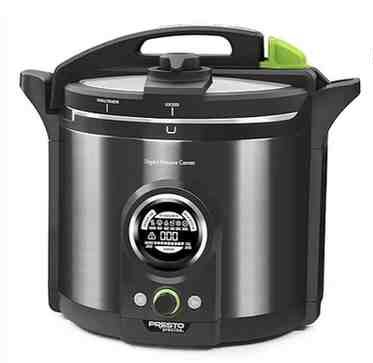
Best Electric/Modern – Presto Digital Pressure Canner
Reason to Buy |
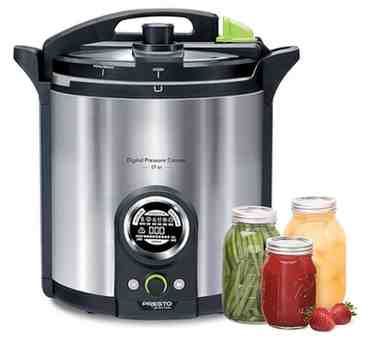
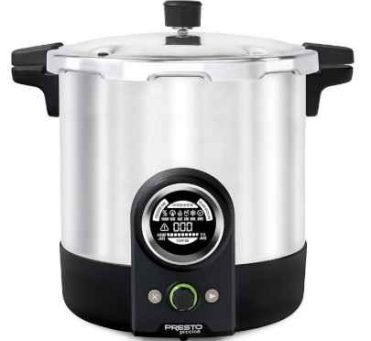
If pressure canning has felt scary or confusing, this canner makes the whole process much easier. The biggest reason to buy the Presto Precise 12-quart is that it automates almost everything. You don’t have to keep an eye on a pressure canner like a stovetop pressure canner, like Presto stovetop pressure canners. A digital pressure canner doesn’t need to watch gauges, adjust heat, or guess timing. The machine guides you step by step on the digital screen.
Another major benefit is the digital control system. It clearly shows each stage, such as heating, venting, canning, and cooling. Because of that, you always know what the canner is doing. If you make a mistake, you can simply hold the cancel button for a few seconds and start over. That alone removes a lot of stress for beginners.
This model is also very beginner friendly. The prompts tell you when to heat jars, when to fill them, when venting is happening, and when processing starts. As a result, it reduces the fear that many people feel about pressure canning safety.
It also works as a water bath canner, so you can use it for fruits, jams, and pickles as well. That means one appliance can handle both pressure canning and water bath canning.
The built-in safety features are another strong point. The lid cannot be opened until pressure is fully released, and the air vent must drop before unlocking. These features help prevent accidents and give peace of mind.
🫙 Jar Capacity
The Presto Precise 12-qt digital pressure canner can hold:
Up to 5 regular-mouth quart jars, or
Up to 8 pint jars
Because of this smaller capacity, it is best for small batches, beginners, or people with limited storage space.
Reason to Ignore this digital pressure canner |
One limitation is the smaller jar capacity. If you often can large harvests or want to process many jars at once, this canner may feel restrictive compared to traditional 22- or 23-quart models.
Another drawback is that it requires electricity. You cannot use it during power outages or outdoors, unlike stovetop pressure canners.
Key Specs |
Brand: Presto | Manufacturer:National Presto Industries| Color: Stainless Steel / Black Dimensions: Height: 10.0 inches | Width: 11.2 inches | Length: 11.4 inches | Jar Capacity: Up to 8 pint quart jars
Explore more electric pressure canners.
FAQs about pressure canner
What to know before buying a pressure canner?
Before buying a pressure canner, the most important things to know are what you plan to can and how often you’ll use it. Make sure the canner you choose meets USDA home canning safety standards — meaning it can reach and hold the right pressure for low‑acid foods like meat, beans, and vegetables. Think about size and jar capacity: larger canners can hold more jars at once, which saves time, but they are heavier and need more storage space. Check what type of pressure indicator it uses — dial gauges require annual testing, weighted regulators are simple and reliable, and digital models can guide you through the process. Also, look at safety features, ease of cleaning or maintaining parts like gaskets, and whether it fits your stove type. If you’re new to canning or want convenience, a digital canner can remove a lot of guesswork. Finally, consider whether you want a heavy‑duty canner for frequent use or a smaller model for occasional batches — because picking the right size and features will make your pressure canning experience much more confident and enjoyable.
What is the best pressure canner for canning?
The best pressure canner for canning depends on how much food you plan to preserve and how often you will use it. For most home canners, the Presto 23-Quart pressure canner is the best all-around choice because it meets USDA safety standards, holds a large number of jars, and offers reliable performance at a reasonable price. If you want a pressure canner built for long-term, heavy use, the All-American 915 stands out thanks to its metal-to-metal sealing system and durable construction. For beginners or those who feel intimidated by traditional pressure canners, the Presto Precise Digital 12-Qt is a great option because it uses guided digital controls and reduces guesswork, though it handles smaller batches. Overall, the best pressure canner is one that safely meets canning standards, fits your batch size needs, and feels comfortable for you to use regularly.
Which pressure canner brand is best?
When people ask me which pressure canner is best, I always start by saying there isn’t one single perfect canner for everyone, but there are clear winners depending on your needs. For most home canners who want a good balance of capacity, safety, and everyday use, the Presto 23‑quart pressure canner is hard to beat — it holds a lot of jars in one batch and follows USDA canning standards. If you want something built to last for years and heavy use, the All‑American 915 stands out because of its rugged metal‑to‑metal seal and reliable gauge, which gives a lot of confidence for frequent canning. For beginners or anyone who feels nervous about pressure canning, the Presto Precise Digital 12‑Qt makes the process much simpler with its guided digital controls, even though it holds fewer jars. In short, the best pressure canner for you depends on how much you can, how often you plan to can, and how comfortable you want the process to be — but those three models consistently impress in real‑world use.
Is it worth buying a pressure canner?
Yes — a pressure canner is worth buying if you plan to preserve foods safely and often, especially meat, vegetables, and low-acid foods. Here’s why, in simple terms:
A pressure canner lets you store food long-term without freezing. Unlike a regular pot, it reaches higher temperatures that are required to safely can low-acid foods like meat, beans, soups, and broth. This means your food stays safe on the shelf for months or even years.
Pressure canning also helps you save money if you grow your own garden, buy meat in bulk, or buy produce on sale. Instead of letting food go bad, you can process it and use it throughout the year.
It’s also very convenient. Once food is canned, you can heat it up quickly for meals without thawing or slow cooking. Many home cooks appreciate having jars of ready-to-eat stews, sauces, or broths on hand.
What size pressure canner should I buy?
If you’re wondering what size pressure canner you should buy, I always tell people to start by thinking about how much food you actually plan to can, not what looks impressive. When I first looked into pressure canners, I realized a smaller model might feel easier to manage, but it also means more batches and more time. A 16-quart canner works fine if you only preserve a few jars at a time or can once in a while, but it fills up fast and can feel limiting as you gain experience.
For most home canners, a 22–23 quart pressure canner is the sweet spot. It lets you process a good number of jars in one run, which saves both time and energy. If you have a garden, buy meat in bulk, or plan to can regularly, this size quickly proves its value. It’s big enough to grow with you, without being overwhelming to use.
If you’re someone who cans often or wants equipment that will last for decades, a heavy-duty canner like the All-American 915 is a solid investment. It’s heavier and costs more upfront, but it’s built for long-term use and large batches. In short, buy the biggest canner you’re comfortable storing and lifting, because most people outgrow a small canner much faster than they expect.